
January 9, 2026
Perspective • Pause • Positioning
January has a funny way of turning both investors and humans into sprinters: new year, new headlines, new goals, new predictions. But outcomes—whether in markets, money, or lifestyle—rarely reward speed for speed’s sake.
Recent global developments, including renewed attention on Venezuela and energy markets, are a reminder that uncertainty is always “on the tape.” We start the year the same way we try to operate all year: with perspective, a deliberate pause (not reacting), and careful positioning for the opportunities that emerge when volatility meets fundamentals. A good example of why we pause: Venezuela holds the world’s largest proven oil reserves, yet years of underinvestment and sanctions have left it producing a relatively small slice of global supply—around the neighborhood of “under 1 million barrels a day” in many recent estimates.
With that mindset, here is what we’re seeing across markets, planning, and behavior—and why we’re choosing discipline over reaction as we look toward 2026.
Alphavest Manager Spotlight:

Patricia Lizarraga, CIO
Hypatia Women CEO ETF, WCEO
What SHE SAID…
“Investing in women CEOs drives change. The visibility of their performance both attracts investors and informs decision makers. More women in leadership, more performance and opportunity for all!” -Patricia Lizarraga
Patricia is the CIO of the WCEO ETF, an investment strategy focused on U.S. public companies led by female CEOs. Her approach is grounded in disciplined portfolio construction and a clear belief: leadership drives performance.
WCEO is built on a simple thesis — women who reach the CEO seat in public markets often bring resilience, accountability, and long-term decision-making that can translate into durable results.
WCEO is now a 5% holding in the Alphavest Dynamic Equity Model (+16.25% 2025 vs. S&P 500 +19.23%) offering a unique alpha opportunity in the Small Capitalization arena.
What she’s focused on:
Investing in American public companies with female CEOs — where leadership and execution converge.
In 2025, Hypatia’s leadership-driven approach outperformed the S&P 600 by 370+ basis points, reinforcing the idea that intentional leadership analysis can be a real source of alpha.
3 For 3
1. Markets: Energy’s Yin–Yang, Market Breadth, and Staying Grounded
What we’re seeing:
Two trends are showing up in investor conversations as 2026 gets underway.
First: market leadership is still concentrated, but there are more signs of broadening participation beneath the surface. Bloomberg highlighted a recent month where the S&P 500 Equal Weight index gained 1.7% while the standard (cap-weighted) S&P 500 rose only 0.3%—a classic “breadth” tell. In the same report, the largest 50 names fell 0.6% while the remaining 450 rose 1.3% (BofA data cited by Bloomberg). (Bloomberg)
Second: energy is back on the front page, partly because geopolitical uncertainty keeps reminding markets where supply constraints can show up. Reuters reported today that Phillips 66 said two Gulf Coast refineries can run up to 100,000 bpd of Venezuelan crude—one practical example of how supply linkages ripple into refining and product markets. (Reuters)
Why we’re pausing (not reacting):
Headline-driven trading is seductive, but it’s usually expensive. Markets often reprice geopolitical shocks quickly—faster than most investors can reposition without adding friction. We’d rather treat news as context, not a call to abandon process. The pause is intentional: it keeps portfolios anchored to cash flows, balance sheets, and valuation discipline rather than mood or frothy sound bytes.
How we’re positioning:
We view energy through a yin–yang lens: traditional integrators on one side and transition technologies on the other. Traditional players like CVX and XOM can provide scale, capital discipline, and shareholder-return frameworks; clean/alternative exposures can provide long-run optionality as the grid evolves. In that spirit, we added Chevron, CVX on 11/4 (+1.64% since), and our Alphavest Equity Income Portfolio (+21.47% 2025 vs. DJIA +14.70%) holding XOM is up over 8% since 11/4 (vs. S&P 500 +1.28% over the same period).
On the transition side, we continue to watch how renewables and “always-on” clean power mature. Bloomberg reported that geothermal developer Fervo Energy raised $462 million (with new and existing investors, including Google). That’s meaningful not because it’s trendy, but because it signals growing capital formation around firm, 24/7 clean power—a need that’s rising with data centers and electrification. (Bloomberg). On the alternative energy side, Equity Income Portfolio Holding, NextEra Energy, NEE yielding 2.79% is a clean energy company, and through its subsidiaries, generates, transmits, distributes, and sells electric energy utilizing natural gas, wind and nuclear resources.
2. Financial Planning: Precision Over Perpetual Change
What we’re seeing:
Investors and planners are shifting from reactive noise chasing to precision planning — thoughtful analysis of imminent structural changes that can materially impact 2026 outcomes. One of the dominant themes in planning conversations right now is understanding how recent tax law changes — particularly the One Big Beautiful Bill Act (OBBBA) — will affect individual tax liabilities, retirement strategies, liquidity needs, and estate intentions.
Under OBBBA, the federal tax landscape for 2026 includes several notable shifts:
- Significantly higher SALT deduction limits — the cap on state and local tax deductions has expanded from $10,000 to roughly $40,000 (with phase-outs for high earners), potentially increasing itemization opportunities for many taxpayers.
- A new 65+ bonus deduction — taxpayers aged 65 and older can claim up to an additional $6,000 deduction (or $12,000 for couples) on top of the existing standard deduction, providing meaningful relief for older households.
- Expanded or new tax-preferred savings vehicles (e.g., “Trump accounts” that allow tax-favored savings for children, and other below-the-line deductions for qualified overtime, tips, or certain vehicle interest).
- Higher indexed tax brackets and standard deduction — the IRS adjusted brackets upward again for inflation, and for tax year 2026 the standard deduction is set at approximately $32,200 for married couples filing jointly and $16,100 for single filers, boosting take-home pay for many.
These changes are feeding an uptick in planning questions around cash flow timing, Roth vs. traditional contribution decisions, itemizing vs. standard deduction strategies, and estate-tax planning.
Why we’re pausing (not reacting):
New tax laws and bracket adjustments can trigger knee-jerk responses, especially around retirement contributions and deductions. But reacting to every headline without context can be harmful; for example, aggressive Roth conversions in a year with expanded standard deductions and larger SALT allowances might actually reduce other deductible benefits or worsen Medicare IRMAA surcharges. Good planning is client specific/scenario-based, not shock-based.
Instead of reacting to drafts or sound bytes, we recommend a careful, scenario-based review of your tax profile — including projected taxable income, filing status, anticipated deductions, and retirement timing — before pulling strategic levers.
How we’re positioning:
Positioning for 2026 means aligning current tax changes with your longer-term goals, not just reacting to each new line item. That includes:
- Comprehensive tax planning reviews that examine how SALT cap changes and higher standard deductions interact with itemizing thresholds
- Retirement contributions strategy that accounts for recent catch-up rule changes (including Roth catch-up requirements for older, high-income participants) and evolving deduction options
- Income sequencing and distribution modeling to anticipate where and when income will be recognized
- Estate and legacy planning updates focused on evolving exemption levels and lifetime gifts/listening goals
3. Lifestyle & Behavior: No Resolutions, Just Direction
What we’re seeing:
January is when everyone becomes a different person… for about, on average…. ten days. The cultural script says: set bold resolutions, reinvent yourself, and sprint into the year. Yet the data (and lived experience) suggests resolutions are hard to sustain.
At the same time, we’re seeing something healthier among many investors: less interest in “big declarations,” and more interest in alignment—how they want to spend time, where they want flexibility, what “enough” means, and how money can support a life that feels intentional rather than performative. Further, investors are deciding to align their portfolios more with their values, and, the time is now for that philosophy to align not only with ones ethics and values, but with alpha, or outperformance from traditional markets.
Why we’re pausing (not reacting):
We’re pausing because January urgency can push people into choices that don’t match who they actually are in March or October. That’s true in portfolios and in life. And here’s the kitschy—but surprisingly useful—reframe: in many traditions, the year hasn’t truly “begun” yet. The Lunar/Chinese New Year in 2026 falls on February 17, associated with the Year of the Fire Horse in popular astrology coverage.
Fire Horse symbolism is fast, dynamic, opportunity-rich—great energy, but also prone to impulsiveness if you don’t know where you’re going. So rather than rushing into rigid resolutions now, we treat January as a runway month: observe what’s working, clarify priorities, and design small changes that can survive real life.
How we’re positioning:
Positioning in lifestyle terms means building systems instead of slogans. If the Fire Horse year is about momentum, the question becomes: momentum toward what? We encourage clients to anchor decisions in a few practical prompts:
- “What would make this year feel successful even if markets are messy?”
- “Where do I want more optionality—time, work, location, health?”
- “Which ‘values’ are non-negotiable, and do my spending and investing reflect them?”
This is also where values-based investing naturally fits. For clients who want it, we can build portfolios that explicitly reflect core values (e.g., no fossil fuels, no big pharma, other exclusions). The point isn’t virtue signaling—it’s reducing internal friction so your plan feels coherent. No resolutions required. Just direction.
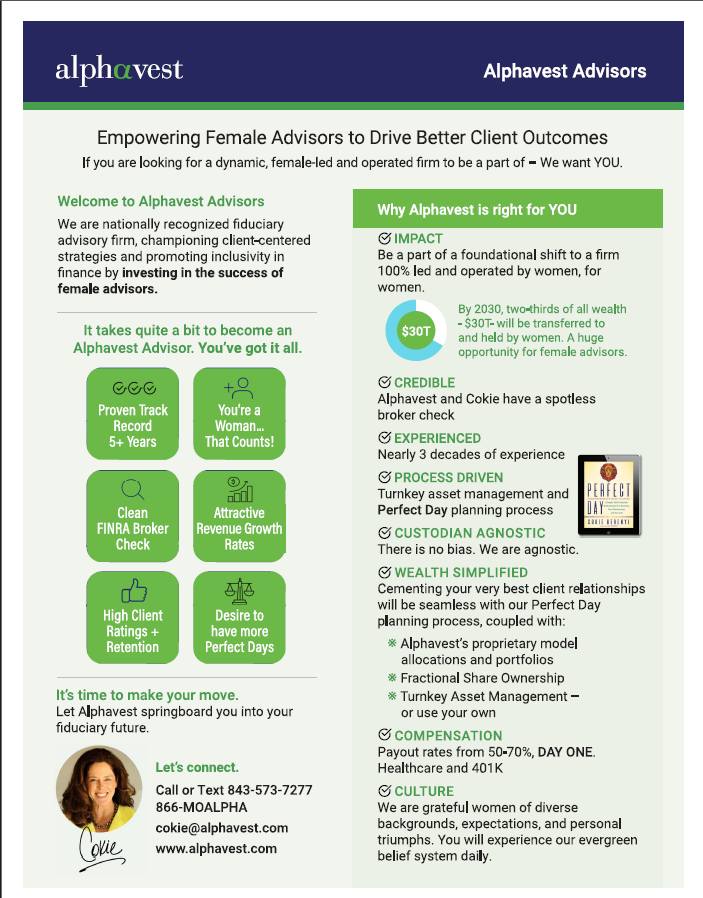
Want to experience the Perfect Day planning process—or need a refresher on your prior Perfect Day efforts? It’s one of the most rewarding activities we do for clients.
Want to experience the Perfect Day planning process—or need a refresher on your prior Perfect Day efforts? It’s one of the most rewarding activities we do for clients. Book a session TODAY.…and, you can considered your resolutions DONE. Happy New Year!
Winners and Losers
YTD Portfolio Winners
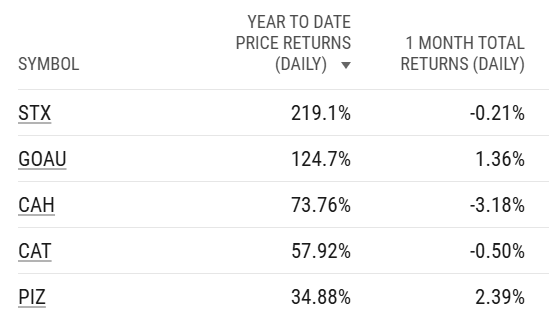
Seagate Technologies/STX tops the YTD winner board. An Alphavest Equity Income (+23.91% 2025 vs. DJIA +17.22%) Model holding, STX boasts a 1.07% (forward) dividend yield. A strong 2nd place, gold miners holding, GOAU led the alternatives portion of the Alphavest Dynamic Equity Model (+16.25% 2025 vs. S&P 500 +19.23%). #5 YTD winner international exchange traded fund/ETF, PIZ, also highlights the diversified Alpha opportunities in the Alphavest portfolios as we seek outperformance with less reliance on Large-cap technology.
MTD Winners
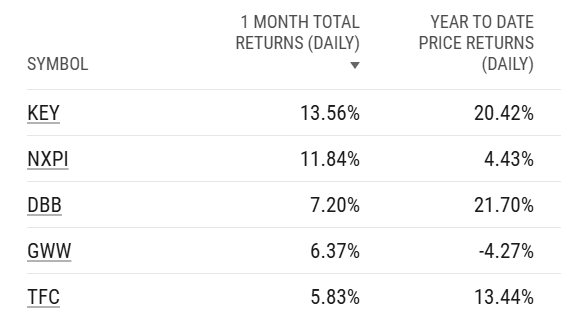
MTD winner #1 Key Corp/KEY an Alphavest Equity Income (+23.91% 2025 vs. DJIA +17.22%) Model holding boasts a healthy 3.85% dividend yield. in the Alphavest Aristocrats (+12.45% YTD/DJIA +13.88%) Model. #5 MTD winner, Truist/TFC also an Equity Income Model holding highlights the strength of financials and dividend yielding stocks over that of the high tech/AI sector.
YTD Portfolio Losers
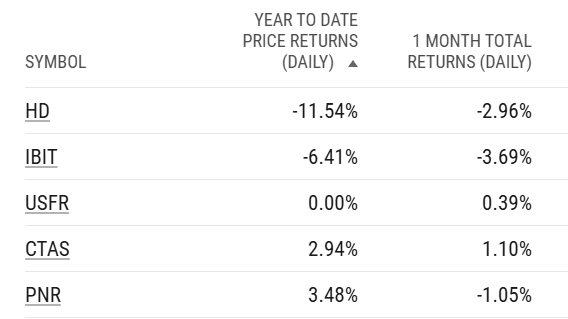
With only 2 positions “in the red” for 2025, we are still holding Alphavest Equity Income (+23.91% 2025 vs. DJIA +17.22%) holding Home Depot/HD, yet with zero technical attributes, and with in negative trend since 11/6/2025 HD is be evaluated for elimination from the portfolio. Bitcoin ETF, IBIT, while #2 loser for 2025, will remain in the Alphavest Dynamic Equity Model (+16.25% 2025 vs. S&P 500 +19.23%) as we continue to diversify and believe in the growth of crypto and stable coin market.
MTD Losers
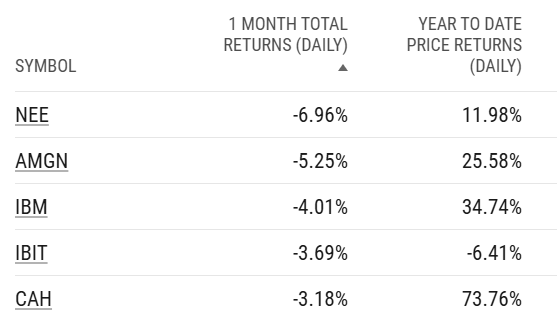
Alphavest Equity Income (+23.91% 2025 vs. DJIA +17.22%) holding NextEra Energy/NEE, mentioned in the above 3 For 3 commentary was up 11.98% in 2025 and boasts a 2.79% dividend yield. We continue to value NEE as a natural gas/nuclear energy AI-adjacent tech utility-tech position. We continue to hold and evaluate AMGN, IBM, IBIT and CAH.

Events on Deck!
Alphavest Lunch and Learn February 11th!
We’re excited to welcome Bryce Gill of First Trust for a timely conversation on the economy, markets, and the forces shaping investor decision-making in the year ahead.
Location: 75 Port City Landing, Mt. Pleasant, SC 29464
Date/Time: Wednesday February 11th at 12:00pm
RSVP to Catherine Ginn at catherine@alphavest to book your spot!
