June 8, 2026
June 3 for 3: Summer, Markets & Keeping Perspective
June has arrived, the farm is impossibly green, and my calendar is beginning to fill with summer adventures. While I’m looking forward to time on the trail and extra time with my girls while they’re home from college, the markets seem determined to keep the Alphavest Team and investors on their toes.
This past week delivered two reminders of the environment we’re in. First, excitement continues to build around the upcoming SpaceX and Anthropic IPOs, a testament to the power of innovation and investors’ appetite for growth. Second, Friday’s selloff reminded us that even in strong markets, uncertainty is never far away.
I was also struck by a recent Economist article on optimism. At a time when headlines seem designed to provoke anxiety, the piece argued that optimism is not naïve—it’s productive. Optimistic people tend to be healthier, more resilient, and more likely to take the actions that create better outcomes. As investors, that’s an important distinction. Optimism isn’t ignoring risk. It’s maintaining confidence that progress, innovation, and human ingenuity can prevail despite the inevitable setbacks along the way.
With that in mind, here are this month’s 3 for 3 observations.
3 For 3
1. Rates and Recession – a date to avoid. Time to rebalance.
The 30-year rate: Our magic eight ball for equity markets
Mohamed El-Erian has been clear in his assessment: we are experiencing a structural — not cyclical — shift toward higher-for-longer inflation, rates, and deficits. The market has so far avoided a significant tantrum largely because corporate America, and the AI-driven tech sector in particular, has been doing the heavy lifting. As El-Erian observes, investors are betting heavily on the enormous promise of AI and strong earnings to carry markets forward. That may continue. But it is a narrow foundation on which to rest an entire market’s valuation.
At Alphavest, we have become increasingly uncomfortable with current equity valuations—not in of the valuations themselves, but when considered with one specific metric; The 30-year Treasury yield. With oil prices elevated and inflation proving stubborn, we believe the 30-year north of 5% is going to serve as a reliable barometer — a kind of magic eight ball for where equities are headed. History supports that discomfort. During every sustained period of 5%-plus long rates — the late 1970s, 1999–2000, and again in 2022 — real equity returns compressed sharply. Valuations came under pressure as bonds became a genuine alternative, borrowing costs rose, and consumer spending softened.
The critical question investors should be asking right now is straightforward: will interest rates stay below 5%? We at Alphavest would very much like the answer to come back — to borrow from the magic eight ball — “Decidedly So.” But the confluence of sticky inflation, elevated oil, and rising deficits suggests the answer may be less certain than equity prices currently imply.
We are watching this closely on your behalf and will continue to communicate our views as conditions develop. Worth the mention as we are being asked quite a bit about the equity allocation of our flagship Alphavest Dynamic Equity Model—our tactical model that shines both in times of growth and market downturns. 2022 is the closest market to what we are currently seeing; hot post COVID equity valuations and interest rates heading toward 5%.
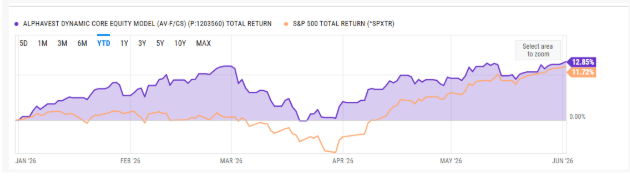
The S&P 500 sold off -18%+ in 2022. Currently the Alphavest Dynamic Equity Model is 86% equities and 14% commodities and YTD returns +12.85% v. 11.72% S&P500. More, in 2022 the Dynamic Equity Model was down -3.97% v. -18.11% S&P500. No matter what the magic eight ball reveals, we’ve got you managed.
2. SpaceX and Antropic IPO’s–BUY or HOLD?
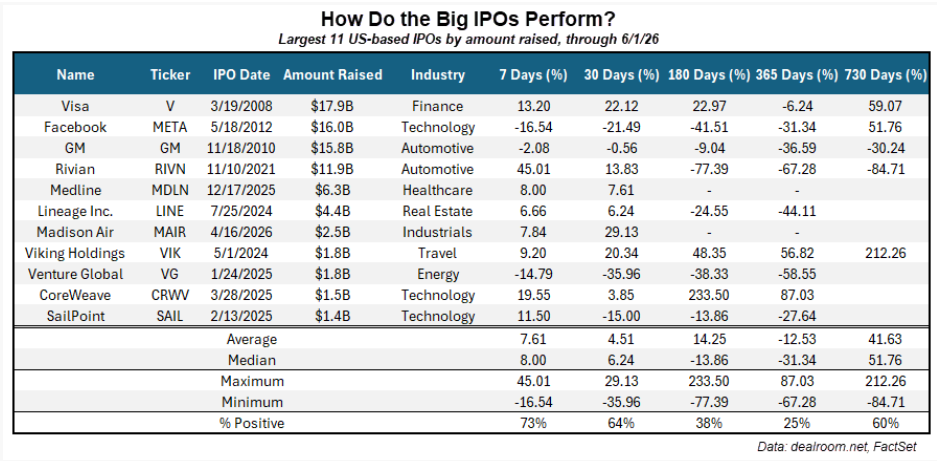
Two of the most anticipated IPOs in recent memory are now approaching. SpaceX is slated to begin trading on the Nasdaq next week, with Wall Street projecting the offering could raise upwards of $75 billion at a valuation exceeding $1.5 trillion — nearly triple the all-time record of $25.6 billion set by Saudi Aramco in 2019, and well above the $17.9 billion raised by Visa in 2008, the largest US IPO on record. Separately, Anthropic, the artificial intelligence company, has also recently filed for a public offering. Together, these listings are drawing significant attention to the IPO market. Alphavest does expect to have an allocation of shares in the SpaceX/Anthropic IPOs available for interested clients. Before making any decisions, however, we want to share some important historical perspective. Ian Saunders of Dorsey Wright & Associates points out that while large IPOs post positive returns in their first week roughly 73% of the time, that success rate drops off considerably in the months that follow. A standard six-month lockup period — during which pre-IPO shareholders are restricted from selling — frequently creates selling pressure once that window expires. Saunders notes that the data, while limited in sample size, suggests patience often rewards investors more than early participation.
Beyond IPO-specific dynamics, current market valuations remain a concern. New listings entering at peak valuations and elevated market levels face meaningful downside risk if sentiment shifts. At Alphavest, our view is straightforward: the appropriate time to evaluate these opportunities is after the initial noise settles, not before.We will be in touch as further details of these offerings become available. Please reach out to your advisor with any questions.Source: Ian Saunders, Dorsey Wright & Associates. Past performance is not indicative of future results. This is not a solicitation or recommendation to buy or sell any security.
3. Choosing Optimism
If you have glanced at the headlines lately, optimism may feel like a reckless choice. Markets have endured sharp selloffs. Wars and geopolitical tensions continue to dominate global conversations. Political polarization has reached levels that leave many people questioning not only where we are headed, but whether we can find our way forward together.
Yet a recent article in The Economist makes a compelling case that optimism is not naïve—it is often one of the most productive forces in human progress.
Research consistently shows that optimistic people tend to be healthier, more resilient, and more successful. They view setbacks as temporary rather than permanent. They believe they have some ability to influence outcomes rather than simply endure them. In business, optimism fuels entrepreneurship. In leadership, it inspires confidence. As Nobel Prize-winning psychologist Daniel Kahneman once observed, a certain amount of “delusional optimism” may even be an engine of capitalism.
Of course, optimism has its limits. Investors who ignore risk can make costly mistakes. Business leaders who refuse to acknowledge reality can drive projects into the ground. The article reminds us that unchecked optimism contributed to excesses before the financial crisis, just as excessive pessimism can prevent people from taking opportunities that ultimately improve their lives.
The challenge, then, is not choosing between optimism and realism. It is learning to hold both at the same time.
As investors, we must acknowledge uncertainty. Markets will decline. Economies will stumble. Political cycles will swing. Global conflicts will arise. Yet history also shows that innovation continues, businesses adapt, and human beings repeatedly solve problems that once seemed insurmountable.
At Alphavest, our Perfect Day philosophy begins with a simple belief: the future can be better than the present. Without that belief, goals become irrelevant, plans lose meaning, and investing becomes little more than risk management. Optimism is not ignoring what could go wrong. It is maintaining confidence in what could go right—and, ‘creating your own economy.’ Ever heard that from me?
In a world increasingly rewarded for cynicism, optimism may be one of the most underappreciated investment strategies of all—not because it guarantees success, but because it creates the conditions that make success possible. Another Alpha opportunity we’re investing in. Dollar cost average a small dose of optimism each day. Returns guaranteed.
Excerpts from this section appeared in the Business section of the print edition of the Economist under the headline “Almost always look on the bright side of life”
Winners and Losers
YTD Winners
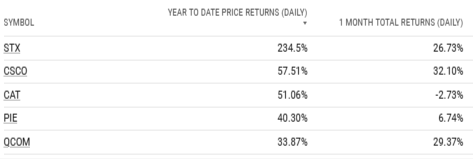
Seagate Technology (STX) tops the YTD winner board with a remarkable +234.5% return, reflecting continued demand for data storage infrastructure supporting AI and cloud computing growth. A holding in select Alphavest equity strategies, STX highlights how beneficiaries of the AI ecosystem extend beyond semiconductors into the critical hardware enabling data-intensive applications. Also among the year’s strongest performers, Cisco (CSCO) and Qualcomm (QCOM) demonstrate the breadth of technology leadership, while Invesco Dorsey Wright Emerging Markets Momentum ETF (PIE) underscores the value of diversified international exposure within Alphavest portfolios.
MTD Winners
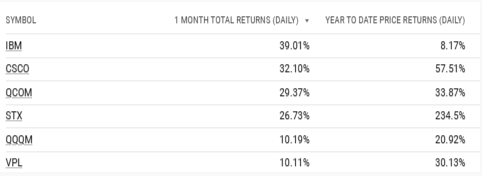
IBM (IBM) leads the monthly winner board with a +39.0% one-month return, as investors continue rewarding companies successfully monetizing artificial intelligence initiatives while maintaining strong enterprise software and services franchises. Fellow technology names Cisco (CSCO), Qualcomm (QCOM), and Seagate Technology (STX) also posted strong gains, reinforcing the market’s continued preference for companies benefiting from digital infrastructure and AI-driven spending trends. Meanwhile, Invesco NASDAQ 100 ETF (QQQM) and Vanguard S&P 500 Value ETF (VPL) highlight participation across both growth and diversified equity exposures.
YTD Losers
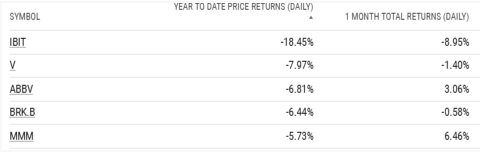
iShares Bitcoin Trust (IBIT) ranks as the largest YTD detractor at -18.5%, reflecting ongoing volatility in digital assets despite strong longer-term adoption trends. Other laggards include Visa (V), AbbVie (ABBV), Berkshire Hathaway (BRK.B), and 3M (MMM), illustrating that several traditionally defensive and quality-oriented holdings have trailed higher-beta technology names during this period. While these positions have underperformed year-to-date, they continue to provide diversification benefits and exposure to sectors beyond the market’s narrow leadership. We are holding all YTD and MTD “losers” as we think they have winning potential.
MTD Losers
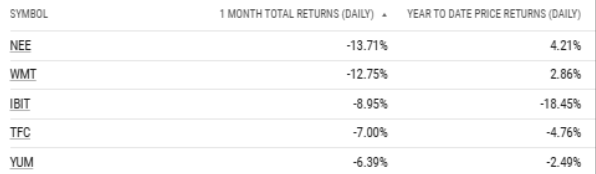
Largest 1-Month Decliners: Defensive and consumer-oriented names led the downside over the past month, with NextEra Energy (NEE) falling 13.7%, followed by Walmart (WMT) (-12.8%) and iShares Bitcoin Trust (IBIT) (-9.0%). Financials also lagged, as Truist Financial (TFC) declined 7.0%, while Yum! Brands (YUM) slipped 6.4%. Despite the recent weakness, NEE and WMT remain positive on a year-to-date basis, up 4.2% and 2.9%, respectively, while IBIT continues to trail with an 18.5% YTD decline.